

AI Governance & Safety: What Every Business Must Know in 2026
AI is moving faster than the rules designed to contain it. Governments are catching up, regulators are watching, and businesses that aren’t prepared are already falling behind. Here’s your complete guide to AI Governance and Safety in 2026.
In boardrooms, government halls, and tech conferences around the world, one question keeps surfacing above all others: who is responsible when AI goes wrong?
It sounds philosophical. But in 2026, it is a very practical, very urgent business question. AI systems are now making decisions about credit approvals, medical diagnoses, hiring, insurance premiums, and criminal sentencing. They are operating with increasing autonomy inside critical infrastructure. And in far too many cases, the humans who deployed them have no clear plan for what happens when those systems make a mistake — or cause harm.
AI Governance and Safety is the field dedicated to answering that question. It encompasses the rules, frameworks, technical standards, and organizational practices that ensure AI systems are trustworthy, accountable, and aligned with human values. And in 2026, it has moved from an academic conversation to a legal and competitive necessity.
In this article, we break down what AI Governance and Safety actually means, what the major regulatory developments look like around the world, what risks organizations face if they ignore this, and what practical steps businesses can take right now to get ahead of the curve.
What Is AI Governance — And Why Does It Matter Now?
AI Governance refers to the set of policies, processes, and structures that organizations use to manage AI responsibly throughout its entire lifecycle — from the moment a model is designed to the moment it is retired.
It covers questions like: How was this AI trained, and on what data? How do we know its outputs are fair and accurate? Who is accountable when it makes a wrong decision? How do we monitor it after deployment? What do we do if it behaves unexpectedly?
For years, these questions were treated as optional — interesting things to think about eventually, once the exciting work of building and deploying AI was done. That era is over.
AI Governance is no longer a nice-to-have. In 2026, in many jurisdictions, it is the law — and in every jurisdiction, it is a boardroom-level risk.
The reason for urgency is simple: AI is now embedded in decisions that affect people’s lives in profound ways. A biased hiring algorithm can deny someone a career opportunity. A flawed credit model can lock a family out of homeownership. A medical AI that underperforms on certain demographics can have life-or-death consequences. Without governance, there is no accountability. Without accountability, there is no trust. And without trust, AI adoption stalls — or worse, causes serious harm.
The Global Regulatory Landscape in 2026
One of the most significant developments of the past two years has been the rapid acceleration of AI regulation across major economies. Here is where things stand:
The European Union — The AI Act
The EU AI Act is the world’s most comprehensive AI regulation and is now fully in force for high-risk applications. It classifies AI systems by risk level — unacceptable, high, limited, and minimal — and imposes strict requirements on those in the high-risk category. These include mandatory technical documentation, human oversight mechanisms, transparency obligations, and conformity assessments before deployment.
High-risk applications include AI used in hiring, education, credit scoring, law enforcement, critical infrastructure, and healthcare. Organizations operating in the EU that fail to comply face fines of up to 35 million euros or 7% of global annual turnover — whichever is higher.
The United States — A Patchwork Approach
The United States has taken a more fragmented approach to AI regulation, with no single federal law equivalent to the EU AI Act. Instead, regulation is developing through a combination of executive orders, sector-specific agency guidance, and state-level legislation. The National Institute of Standards and Technology (NIST) AI Risk Management Framework has become a widely adopted voluntary standard, and several states — including California, Colorado, and Texas — have passed their own AI accountability laws targeting specific use cases.
China — Focused and Mandatory
China has moved decisively on AI regulation in specific domains. Its regulations on generative AI services, algorithmic recommendations, and deep synthesis technology are among the most detailed in the world for those specific applications. Organizations operating in China must comply with requirements around content moderation, transparency, and security assessments.
The United Kingdom — Pro-Innovation but Watchful
The UK has adopted a principles-based approach, relying on existing sector regulators to apply AI governance within their domains rather than creating a single overarching law. This is designed to remain flexible as the technology evolves. However, the government has signaled that binding legislation is on the horizon if voluntary measures prove insufficient.

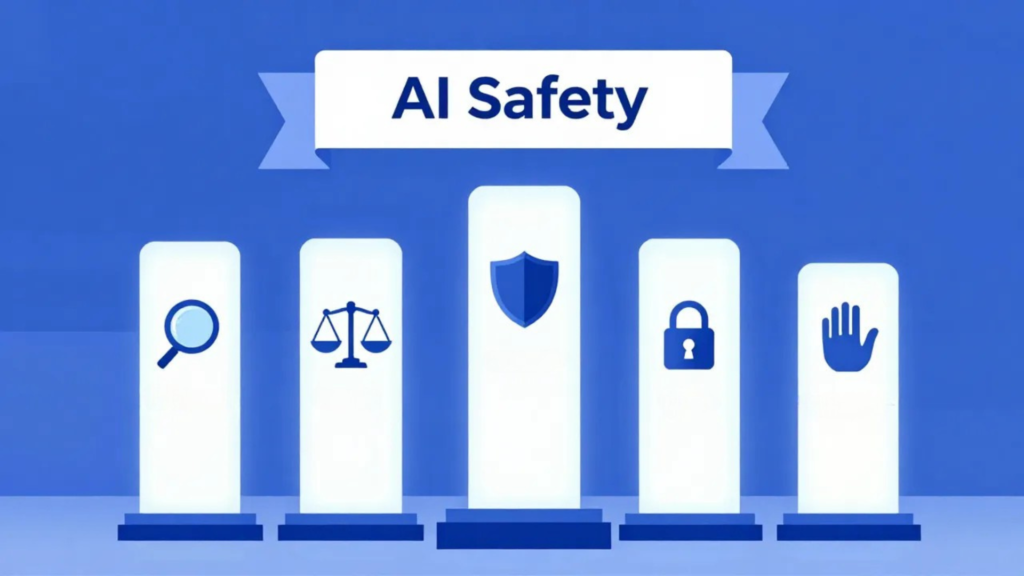
The Key Pillars of AI Safety
Governance is the organizational and regulatory side of responsible AI. Safety is the technical side. Together, they form the foundation of trustworthy AI deployment. Here are the core pillars every organization needs to understand:
Transparency and Explainability
An AI system that cannot explain its decisions is a liability in any regulated context. Explainability means being able to articulate — in terms a human can understand — why the AI reached a particular conclusion. This is not just a technical challenge; it is a fundamental requirement for accountability. Regulators, affected individuals, and auditors all have legitimate interests in understanding how AI decisions are made.
Fairness and Bias Mitigation
AI systems trained on historical data frequently inherit and amplify the biases present in that data. Left unchecked, this can result in discriminatory outcomes at massive scale — far faster and more efficiently than any human could produce. Responsible AI governance requires systematic testing for bias across demographic groups, documented mitigation strategies, and ongoing monitoring after deployment.
Robustness and Reliability
An AI system that performs brilliantly in a test environment but degrades unpredictably in the real world is dangerous. Safety requires rigorous testing across a wide range of conditions — including adversarial inputs designed to confuse or manipulate the system. It requires clear performance benchmarks, monitoring systems that detect drift or degradation over time, and defined protocols for when to take a system offline.
Privacy and Data Protection
Most AI systems are only as good as the data they’re trained on — which means most AI systems are built on vast quantities of personal information. Responsible governance requires that organizations understand exactly what data they are using, obtain appropriate consent, implement data minimization practices, and ensure that AI systems cannot be used to re-identify individuals from anonymized datasets.
Human Oversight and Control
Even the most capable AI systems should operate within boundaries defined by humans. High-stakes decisions — those with significant consequences for individuals or organizations — should always have a human in the loop who has genuine authority and practical ability to override the AI. Governance frameworks must define clearly which decisions require human sign-off, and that list should err heavily on the side of caution.
What Happens to Businesses That Ignore This?
The risks of inadequate AI governance are no longer theoretical. Organizations that fail to take this seriously face consequences across multiple dimensions:
- Regulatory fines and legal liability: Under the EU AI Act and emerging US state laws, non-compliance with AI governance requirements carries significant financial penalties. Beyond fines, organizations face growing exposure to civil litigation from individuals harmed by AI decisions.
- Reputational damage: High-profile AI failures — a biased hiring tool, a flawed content moderation system, an autonomous vehicle accident — attract intense media scrutiny. The reputational damage from a single well-publicized AI failure can take years to repair.
- Loss of customer trust: Consumers are increasingly aware that AI is making decisions about them. Organizations perceived as reckless or opaque in their AI use lose customer trust — and in competitive markets, that translates directly to lost revenue.
- Competitive disadvantage: As enterprise procurement processes increasingly include AI governance assessments, organizations that cannot demonstrate responsible AI practices will find themselves excluded from partnerships, contracts, and supply chains.
- Operational failures: Poorly governed AI systems that degrade, drift, or behave unexpectedly can cause significant operational disruptions. Without monitoring and oversight processes in place, these problems often go undetected until they have already caused serious harm.
Building an AI Governance Framework: Where to Start
For many organizations, the challenge of AI governance feels overwhelming — especially when the technology itself is evolving so rapidly. The good news is that you do not need to solve everything at once. Here is a practical starting point:
1.Take an Inventory of Your AI
Before you can govern your AI systems, you need to know exactly what they are, where they operate, what decisions they influence, and what data they use. Many organizations are surprised to discover how many AI systems — including third-party tools and embedded vendor algorithms — are already in use across their operations. Start with a comprehensive audit.
2.Classify Your AI by Risk Level
Not all AI applications carry the same risk. A system that recommends internal training resources carries far less risk than one that makes credit decisions or screens job applicants. Apply a risk classification framework — the EU AI Act’s categories are a reasonable starting point — and prioritize your governance efforts on the highest-risk applications first.
3.Assign Ownership and Accountability
Every AI system in your organization should have a named owner who is accountable for its performance, its compliance with applicable regulations, and its behavior in production. This is not a technical role — it is a leadership role. The AI owner is responsible for governance, not just deployment.
4.Implement Monitoring and Audit Trails
Governance without visibility is meaningless. Every consequential AI decision should be logged in a way that allows retrospective audit. You need to be able to answer: what did the system decide, on what basis, at what time, with what outcome? Without this record, accountability is impossible.
5.Establish an AI Ethics Review Process
Before deploying any new AI system — and periodically throughout its operational life — conduct a structured ethics review. This should assess potential harms, test for bias, evaluate Explainability, confirm compliance with applicable regulations, and document the organization’s reasoning for proceeding with deployment.
The Human Side of AI Safety
Technology frameworks and regulatory compliance are necessary — but they are not sufficient. The most important element of AI governance is organizational culture.
Organizations where employees feel empowered to raise concerns about AI systems — where raising a flag about a potentially biased model is celebrated rather than discouraged — are far more likely to catch problems early and avoid the high-profile failures that dominate headlines.
This requires leadership that treats AI safety as a genuine organizational value, not a compliance checkbox. It requires training that helps non-technical staff understand the AI systems they work with well enough to notice when something seems wrong. And it requires processes that make it easy for anyone in the organization to escalate an AI concern without fear of it being dismissed or ignored.
The organizations that will be most trusted with AI are not the ones that deploy it the fastest. They are the ones that deploy it the most responsibly.
Final Thoughts
AI Governance and Safety is one of the defining challenges of the 2020s. As AI systems grow more capable, more autonomous, and more deeply embedded in decisions that shape people’s lives, the frameworks we build to govern them will determine whether this technology is a force for broad human benefit or a source of new inequalities, harms, and failures.
For businesses, the message is clear: this is not a problem you can outsource to regulators or defer to your legal team. AI governance is a strategic priority that belongs at the leadership level, deserves dedicated resources, and requires action today — not after your first compliance failure.
The organizations that invest in responsible AI practices now will be the ones that earn the trust of customers, regulators, and partners in the years ahead. That trust, in a world where AI is everywhere, will be one of the most valuable competitive assets a company can hold.