Spatial Computing: How the Merger of Physical and Digital Worlds Is Redefining Everything
Screens are disappearing. The internet is stepping out of your device and into the room around you. Spatial Computing is the technology making that happen — and in 2026, it is no longer a prototype. It is a platform.
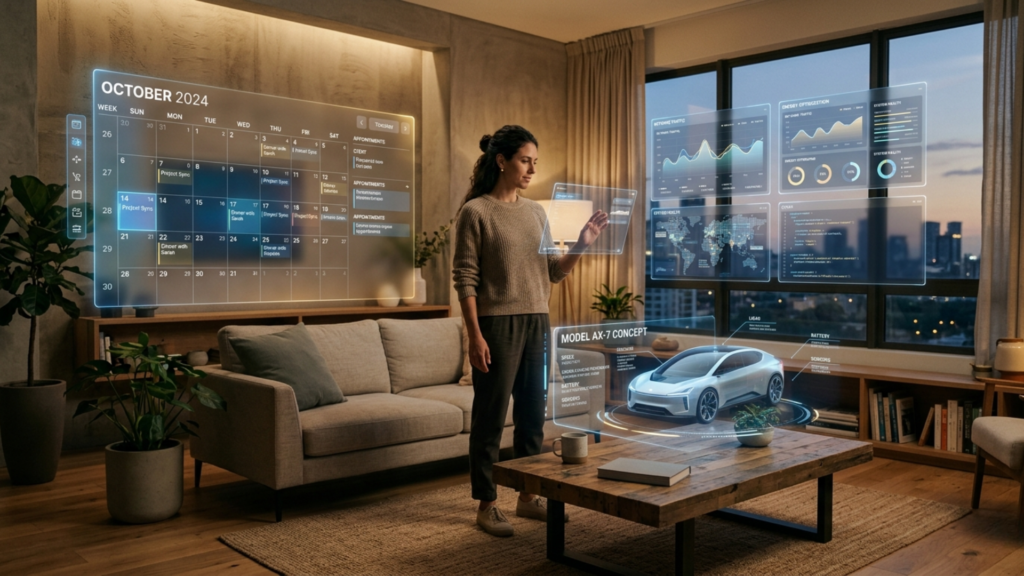
Spatial Computing is the technology that blends the physical and digital worlds so seamlessly that the boundary between them begins to dissolve. Instead of interacting with computers through flat screens, keyboards, and touchpads, Spatial Computing allows you to interact with digital information as if it exists in the three-dimensional space around you — pinned to real objects, floating in mid-air, responding to your gaze, your voice, and your hands. It is the technology underlying augmented reality, mixed reality, and the most advanced virtual reality systems, and in 2026 it has crossed a critical threshold: it is no longer a novelty or a gaming curiosity. It is a serious enterprise platform, a transformative educational tool, a new frontier in healthcare, and the foundation of what many technologists believe will be the next major computing paradigm after the smartphone.
The launch of Apple Vision Pro in 2024 marked a watershed moment — not because the product itself immediately dominated the market, but because it signaled that the world’s most valuable technology company had committed its full engineering and design resources to Spatial Computing as the next major platform. Where Apple goes, the industry follows, and the wave of investment, developer attention, and competitive products that followed has accelerated the entire field dramatically.
In this article, we explain exactly what Spatial Computing is, how it works, why it matters far beyond gaming and entertainment, where it is already delivering genuine value across industries, what challenges remain, and what forward-thinking professionals and organizations need to understand to prepare for the spatial era.
What Is Spatial Computing? Understanding the Core Concept
The term Spatial Computing was popularized by researcher Simon Greenwold in 2003, who defined it as human interaction with a machine in which the machine retains and manipulates referents to real objects and spaces. In plain English, it means computing that understands and operates within three-dimensional physical space — rather than treating the world as flat input and output surfaces.
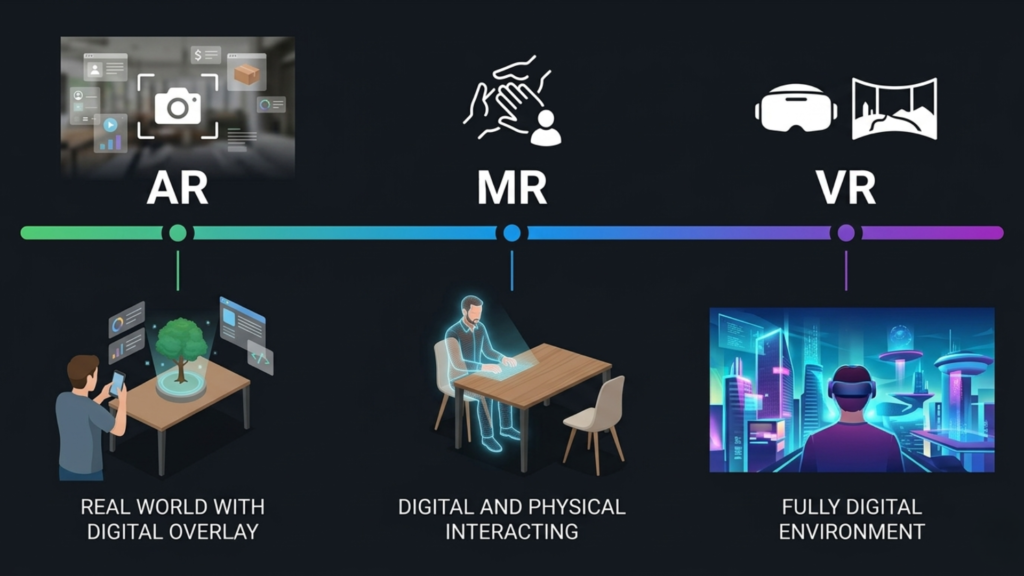
Spatial Computing encompasses several related technologies that exist on a spectrum from entirely physical to entirely digital:
- Augmented Reality (AR): Digital content overlaid onto the real world. You see the physical environment around you, with digital elements added on top — instructions floating above a piece of machinery, navigation arrows overlaid on a street, a virtual product placed in your living room before you buy it.
- Mixed Reality (MR): A deeper integration where digital objects are anchored to and interact with the physical world. A holographic colleague sitting across a real table from you. A digital design physically placed on a real factory floor. The digital and physical coexist and respond to each other.
- Virtual Reality (VR): A fully digital environment that replaces the physical world entirely. Used for simulation, training, design review, and immersive experiences where full environmental control is needed.
- Extended Reality (XR): The umbrella term covering the full spectrum from AR through MR to VR — all the ways digital and physical reality can be combined or substituted.
Spatial Computing does not put a screen in front of your face. It turns the world around you into the screen — making digital information part of your physical reality rather than a window separate from it.
What makes Spatial Computing more than just a fancier display technology is the intelligence layer that underlies it. Modern spatial computing systems use computer vision to understand the geometry of the surrounding environment in real time, AI to interpret what they are looking at, sensors to track the position and movement of the user’s head, hands, and eyes with millimeter precision, and rendering engines that place digital content convincingly in three-dimensional space. The result is an experience that feels natural in a way that interacting with a flat screen never truly does.
Spatial Computing Technology: What Powers It
Behind every compelling spatial computing experience is a sophisticated stack of hardware and software technologies working in concert. Understanding these components helps explain both what is possible today and why the technology has taken as long as it has to mature:
Spatial Mapping and Environment Understanding
For digital content to appear convincingly placed in the real world, the spatial computing system must build and continuously update a three-dimensional model of the surrounding environment. This is accomplished through a combination of depth sensors, cameras, and computer vision algorithms that detect surfaces, understand geometry, track lighting conditions, and identify real-world objects. Apple Vision Pro uses a combination of LiDAR sensors, cameras, and on-device AI processing to build this spatial map in real time with exceptional accuracy. This environmental understanding is what allows a virtual object to sit convincingly on a real table, cast appropriate shadows, and be occluded by real objects that pass in front of it.
Eye and Hand Tracking
Spatial computing interfaces are controlled not by keyboards and mice but by the most natural human input mechanisms — gaze, gesture, and voice. Eye tracking systems monitor exactly where the user is looking, allowing interface elements to respond to attention before any deliberate action is taken. Hand tracking systems use cameras and computer vision to detect the position and movement of fingers and hands in real time, enabling direct manipulation of virtual objects with bare hands. These interaction modalities feel immediately intuitive in a way that learning a new controller layout never does.
Display Technology
Creating the illusion that digital content exists in physical space requires displays capable of presenting slightly different images to each eye at extremely high resolution, refresh rates, and with precise optical alignment. The optical systems in leading spatial computing headsets — micro-OLED displays, pancake lens designs, and waveguide optics — represent some of the most sophisticated consumer display engineering ever produced. Getting the visual experience right is one of the hardest engineering challenges in spatial computing, and it is an area of rapid ongoing improvement.
On-Device AI Processing
Spatial computing requires enormous real-time computational work — environment mapping, object recognition, hand tracking, eye tracking, rendering, and more — all happening simultaneously with sub-millisecond latency. Cloud processing is too slow for this workload. All of it must happen on-device, which has driven the development of specialized spatial computing chips — like Apple’s R1 chip in Vision Pro, designed specifically to process sensor data with the speed required for comfortable, lag-free spatial experiences.
Spatial Computing Use Cases Transforming Industries Today
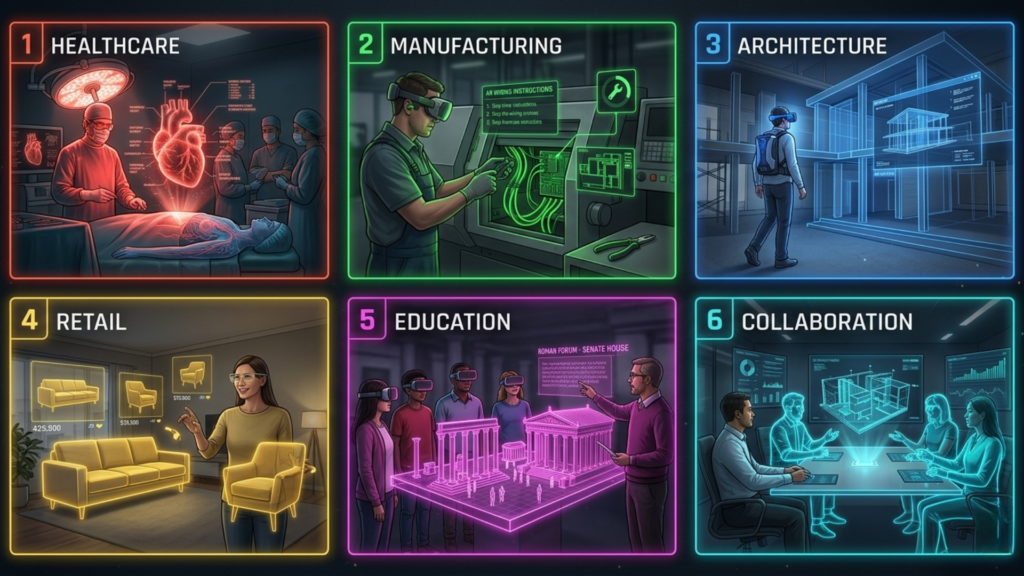
Spatial Computing is already well beyond the demo stage. Here are the industries where it is delivering documented, measurable value in 2026:
Healthcare — Surgery, Training, and Patient Care
Spatial Computing has found some of its most powerful applications in medicine. Surgeons use mixed reality headsets to visualize patient anatomy data — CT scans, MRIs — overlaid directly onto the surgical field, giving them real-time three-dimensional guidance without taking their eyes off the patient. Medical students train on virtual patients in VR environments that simulate rare and high-stakes procedures with realism that mannequin-based simulation could never approach. Physical therapy patients use AR systems that guide them through rehabilitation exercises with real-time form feedback, improving adherence and outcomes while reducing the need for in-person therapist supervision.
Manufacturing and Industrial Operations
Industrial applications of Spatial Computing are among the most mature and economically significant. Boeing uses AR headsets to guide technicians through complex aircraft wiring procedures, displaying the exact wire to pick up, where to route it, and where to connect it — directly in the technician’s field of view. The result was a reported 25% reduction in production time and a near-elimination of wiring errors. Factories use spatial computing for remote expert assistance — a field technician encountering an unfamiliar problem puts on a headset, and a remote expert sees exactly what they see, drawing annotations in their field of view to guide the repair in real time.
Architecture, Engineering, and Construction
Design professionals are using Spatial Computing to transform how buildings, products, and infrastructure are conceived, communicated, and built. Architects walk clients through full-scale virtual models of buildings that have not yet been constructed. Engineers review complex mechanical assemblies at true scale, identifying interference problems and design issues that are invisible in flat 2D drawings. Construction teams use AR to overlay building information models onto construction sites, verifying that physical construction matches digital design with centimeter precision before problems become expensive mistakes.
Retail and E-Commerce
The inability to physically experience a product before purchase is one of the most persistent friction points in e-commerce. Spatial Computing is eliminating it. IKEA, Wayfair, and dozens of other retailers allow customers to place true-to-scale virtual versions of products in their own homes using smartphone AR before purchasing. Cosmetics brands let customers virtually try on makeup. Eyewear retailers let customers see exactly how glasses will look on their face. These spatial commerce experiences are demonstrably reducing return rates and increasing purchase confidence — delivering measurable business value alongside better customer experience.
Education and Training
The classroom is one of the most compelling settings for Spatial Computing. Students dissecting virtual frogs in biology class, walking through ancient Rome in history class, conducting chemistry experiments in environments where mistakes have no real-world consequences, and learning complex spatial concepts in mathematics and physics through three-dimensional visualization — all of these experiences produce deeper understanding and better retention than textbook and screen-based instruction alone. Enterprise training programs are using VR simulations to train employees in high-stakes scenarios — emergency response, customer conflict resolution, equipment operation — with a realism and safety that no classroom exercise can match.
Remote Collaboration
The limitations of video conferencing — the flatness, the artificiality, the absence of spatial presence — have driven significant interest in spatial computing as the next evolution of remote collaboration. Microsoft Mesh, Meta Horizon Workrooms, and Apple’s FaceTime Personas in Vision Pro all represent steps toward spatial meetings where participants are represented as three-dimensional avatars or photorealistic personas sharing a virtual space. Early enterprise adopters report that spatial collaboration feels meaningfully more engaging and productive than video calls for complex collaborative work — design reviews, strategic planning, and hands-on training sessions in particular.
Spatial Computing and AI: The Combination That Changes Everything
Spatial Computing and Artificial Intelligence are not merely parallel trends — they are deeply interdependent technologies that multiply each other’s power when combined.
AI is what makes spatial computing intelligent rather than merely immersive. Computer vision AI understands what the spatial computing system is looking at — recognizing objects, reading text, understanding scenes. Natural language AI allows users to interact with spatial applications by speaking naturally rather than navigating menus. Machine learning enables spatial systems to personalize experiences based on user behavior and preferences. And generative AI is beginning to enable the real-time creation of spatial content — virtual environments, three-dimensional objects, interactive experiences — from natural language descriptions.
In the other direction, Spatial Computing gives AI a physical interface that fundamentally changes how AI assistance is experienced. An AI assistant that can see what you see, understand the physical context you are operating in, and overlay relevant information directly in your field of view is qualitatively different from an AI assistant accessed through a chat box on a flat screen. This combination — spatially aware, physically grounded AI — is what many researchers and product designers believe will define the next generation of human-computer interaction.
Spatial Computing gives AI eyes, a body, and a place in the physical world. AI gives Spatial Computing the intelligence to understand what it sees and make it genuinely useful. Together, they are more powerful than either could be alone.
Challenges Holding Spatial Computing Back in 2026
For all its promise, Spatial Computing faces genuine challenges that are limiting its pace of adoption:
- Hardware comfort and form factor: Current spatial computing headsets remain bulky, heavy, and uncomfortable for extended wear compared to glasses or nothing at all. The form factor that will drive mass consumer adoption — lightweight, stylish, all-day-wearable smart glasses — is still several hardware generations away from current devices. This limits most spatial computing deployments to use cases where the productivity benefit justifies wearing a headset for focused work sessions.
- Cost barriers: High-quality spatial computing hardware remains expensive. Apple Vision Pro launched at $3,499. Enterprise-grade mixed reality headsets from Microsoft and others carry similar or higher price points. While costs are declining, widespread consumer adoption requires hardware at consumer-friendly price points that the market has not yet reached.
- Content and application ecosystem maturity: The spatial computing application ecosystem is still developing. The killer applications that will drive mass adoption — comparable to email for the PC or social media for the smartphone — have not yet definitively emerged. Developers are building, but the ecosystem is a fraction of the size of mobile.
- Health and safety considerations: Extended use of spatial computing headsets raises unresolved questions about eye strain, motion sickness, and the psychological effects of extended blending of physical and digital reality. These concerns are particularly significant for applications targeting children and for use cases requiring continuous all-day wear.
- Privacy implications: Spatial computing devices that continuously map their environment, track the user’s gaze, and potentially recognize faces and objects in the real world create profound privacy questions — both for the user and for anyone in the vicinity of a spatial computing device. Navigating these privacy implications will require both technical solutions and clear regulatory frameworks.
How Organizations Should Prepare for the Spatial Computing Era
The organizations that will lead in the Spatial Computing era are not necessarily those with the biggest technology budgets — they are the ones that start building understanding and capability now, before the technology reaches mainstream scale. Here is a practical preparation roadmap:
- Identify Your Highest-Value Spatial Use Cases
Start by identifying the workflows in your organization where three-dimensional visualization, spatial context, or immersive experience would deliver the most value. Complex assembly and maintenance procedures, design review processes, training for high-stakes scenarios, and remote expert assistance are strong starting points for most industries. The goal is to find the use case where Spatial Computing solves a real problem that current tools handle poorly.
- Run Focused Pilots Before Broad Deployment
Spatial Computing pilots should be narrow, measurable, and tied to specific business outcomes — reduced training time, fewer errors in assembly, faster design review cycles. Avoid broad exploratory deployments that lack clear success metrics. A well-designed pilot produces evidence for broader investment and builds institutional knowledge about what works in your specific operational context.
- Build Spatial Development Capability
The market for spatial computing developers is competitive and the talent pool is limited. Organizations that begin building internal capability now — whether by training existing developers on spatial platforms like Apple’s visionOS, Unity, or Unreal Engine, or by partnering with specialized spatial development studios — will be better positioned than those that wait until the market is mainstream and talent is even scarcer. - Engage With the Platform Ecosystem
Spatial computing platform decisions made now — which operating systems to develop for, which hardware vendors to partner with, which spatial development frameworks to standardize on — will have long-term implications. Staying actively engaged with platform developments from Apple, Meta, Microsoft, and emerging players ensures that your technology choices align with where the ecosystem is heading.
Final Thoughts: Spatial Computing Is the Next Computing Platform
Every generation of computing has been defined by a new interface paradigm — the command line gave way to the graphical user interface, which gave way to the touchscreen, which is now giving way to spatial interaction. Spatial Computing is not just a new type of application. It is the next fundamental model for how humans and computers interact.
The transition will not happen overnight. The hardware is still maturing, the application ecosystem is still developing, and the social norms around spatial computing in shared physical spaces are still being negotiated. But the direction is clear, the investment is massive, and the underlying technology is advancing at a pace that makes the question not whether Spatial Computing will become a dominant platform, but when.
The organizations and professionals that develop spatial computing literacy, run thoughtful pilots, build relevant capabilities, and position themselves ahead of the mainstream adoption curve will be the ones that define how their industries operate in the spatial era. The window to get ahead of this technology is open right now — and it will not stay open indefinitely.