
Agentic AI: The Next Big Leap in Artificial Intelligence
AI used to wait for your command. Agentic AI doesn’t wait — it thinks, plans, and acts on its own. Here’s what that means for you, your business, and the world.
Picture this: you walk into work one morning and everything that used to sit in your to-do list — the emails, the reports, the data pulls, the follow-ups — is already done. Not by a person. Not by a simple bot following a rigid script. Done by an AI that understood your goal, figured out the steps needed to get there, and executed every single one of them overnight.
That’s not a scene from a science fiction film. That’s Agentic AI — and in 2026, it is already running inside some of the world’s most competitive companies.
For most of the past decade, artificial intelligence was powerful but passive. You prompted it, it responded. You uploaded a document, it summarized it. Every interaction was a one-way exchange — human initiates, AI reacts. Agentic AI fundamentally breaks that model. It introduces something AI has never truly had before: genuine initiative.
In this article, we break down exactly what Agentic AI is, how it works under the hood, where it’s being deployed right now, what risks it carries, and what you need to do to stay ahead of the curve.
What Is Agentic AI? A Simple Explanation
At its most basic, Agentic AI refers to AI systems that can pursue goals autonomously — without needing a human to guide each step of the process.
Traditional AI tools, including popular Large Language Models (LLMs), operate in a single-turn fashion. You ask something, they answer. You give a task, they complete that specific task. They’re brilliant at responding but incapable of proactively doing anything on their own.
Agentic AI is a different animal entirely. Feed it a goal — “research the top 10 competitors in our market and produce a comparison report” — and it will independently decide what steps to take, which tools to use, what information to retrieve, and in what order to do everything. It doesn’t ask for clarification at each turn. It reasons through the problem, acts on its reasoning, evaluates the result, and adjusts if something goes wrong.
Generative AI is a brilliant writer who works when asked. Agentic AI is a brilliant strategist who works whether you’re watching or not.
The key capabilities that make this possible include: access to external tools and APIs, the ability to browse the web, run code, interact with databases, persistent memory across sessions, multi-step planning, and in many deployments, the ability to coordinate with other AI agents to divide complex work.
How Agentic AI Works: The Core Loop
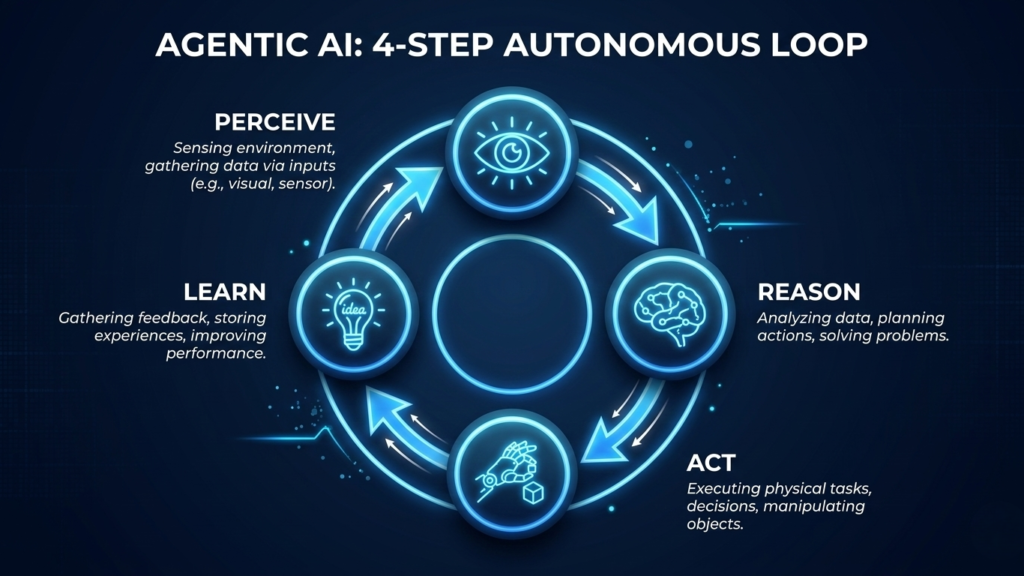
Every Agentic AI system — regardless of the platform or the industry it serves — operates through a continuous four-phase cycle. Understanding this loop is the key to understanding what makes these systems so powerful.
Phase 1: Perceive
The agent starts by gathering context. This includes everything relevant to the goal at hand — data from internal systems, information pulled from the web, documents, user inputs, API responses, or live sensor feeds. Before it decides anything, it builds a complete picture of the situation.
Phase 2: Reason
Using a Large Language Model as its core reasoning engine, the agent analyzes the information it has gathered, forms a plan, and decides what to do next. This phase often involves techniques like Retrieval-Augmented Generation (RAG), which allows the agent to pull accurate, specific information from private data sources rather than relying solely on what the model was trained on. The agent breaks the overall goal into smaller sub-tasks and prioritizes them.
Phase 3: Act
The agent executes its plan. This might mean writing and running code, filling out a web form, sending an email, calling an external API, generating a document, creating a calendar event, or triggering another automated process. Critically, the agent monitors whether each action is moving it toward the goal — and reroutes if it isn’t.
Phase 4: Learn
Unlike traditional automation tools that follow a fixed script and never improve, Agentic AI systems can adapt over time. They retain memory of past interactions, store outcomes, and use that history to make better decisions in future tasks. The more they operate, the more effective they become.
This loop — perceive, reason, act, learn — runs continuously and often entirely without human input until the task is fully complete. The agent only escalates to a human when it encounters a decision that falls outside its authority or when an action carries high-stakes consequences that require sign-off.
Agentic AI vs. Generative AI: What’s the Difference?
These two terms are frequently confused — and sometimes deliberately blurred by vendors who want to make their products sound more advanced than they are. Here’s a clean breakdown:
- Generative AI creates content in response to a prompt — text, images, code, audio. It is reactive and operates in a single exchange.
- Agentic AI pursues goals across multiple steps and sessions. It is proactive, uses tools, makes decisions, and executes actions in the real world.
- Generative AI is the engine. Agentic AI is the driver.
A ChatGPT conversation is generative AI. An AI system that monitors your inbox, drafts replies, schedules meetings, updates your CRM, and sends weekly reports — all without being told to each time — that is Agentic AI.
Where Is Agentic AI Being Used Right Now?
This is not a technology that’s five years away. It is operational today, at scale, across multiple industries. Here are some of the most significant real-world deployments:
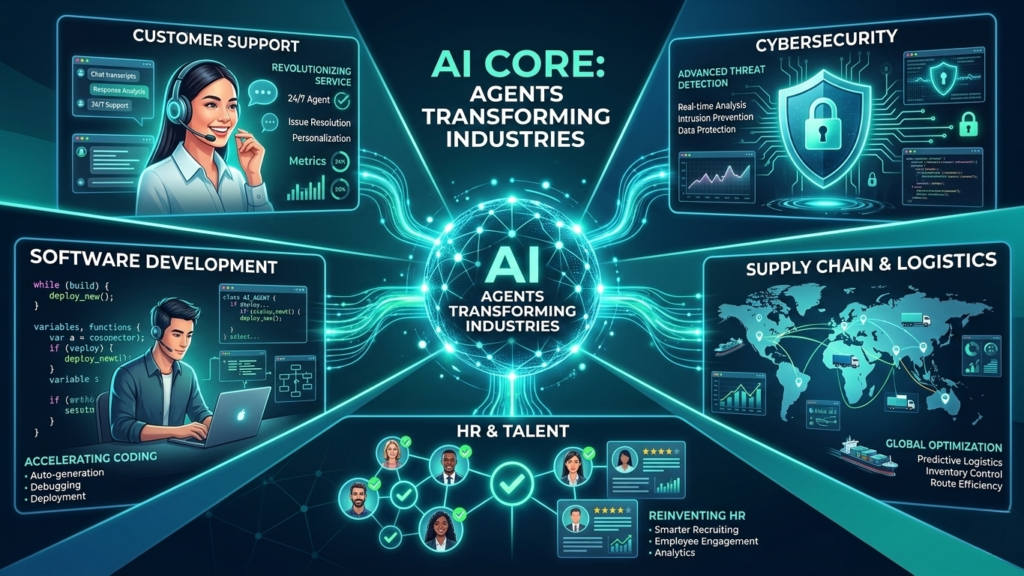
Customer Support
Modern Agentic AI in customer service doesn’t just answer questions — it resolves them end-to-end. The agent reads the customer’s account history, checks current policies, identifies the root cause of the issue, executes the fix, and closes the ticket. No human agent touches the case unless it involves an edge case that requires judgment. Companies across banking, retail, and telecom are already reporting resolution time reductions of 60% or more after deploying these systems.
Software Development
AI coding agents are transforming how development teams work. GitHub’s autonomous coding agents can be assigned tasks directly — fix this bug, build this feature, refactor this module — and they will open a sandboxed environment, do the work, run tests, and submit a pull request. The developer reviews and merges. The agent does everything in between.
Cybersecurity
Security Operations Centers deal with thousands of alerts every day. The sheer volume makes human-only analysis impossible. Agentic AI systems now triage incoming alerts, rank them by severity, begin investigation workflows, correlate patterns across systems, and for pre-approved low-risk actions, respond automatically. Microsoft Security Copilot and Google’s DeepMind agents are already catching threats that human analysts were missing due to alert fatigue.
Supply Chain Management
Supply chains are too complex and too fast-moving for manual oversight. Agentic AI monitors inventory, shipping routes, supplier performance, weather events, and demand fluctuations in real time — simultaneously. When a disruption occurs, the agent doesn’t wait for a manager to notice. It reroutes, reorders, and rebalances automatically, keeping operations running smoothly without human delay.
Human Resources
HR departments process enormous volumes of repetitive requests — leave applications, payroll queries, onboarding documentation, policy questions. Agentic AI handles these at scale, around the clock, freeing HR teams to focus on strategy, culture, and the complex people decisions that genuinely require human empathy and judgment.
The Risks You Need to Take Seriously
Agentic AI is powerful — but that power comes with real risks that no responsible technology publication should gloss over. Here is what organizations need to watch carefully:
- Accountability: When an autonomous agent makes a consequential mistake — rejecting a loan application, sending incorrect information, triggering an unintended process — it is not always clear who bears responsibility. Organizations must define this before deploying agents, not after.
- Security: Agents that have access to enterprise systems, APIs, and databases create new attack surfaces. A poorly configured agent with excessive permissions can be manipulated into leaking sensitive data or triggering harmful actions.
- Over-automation: Not every process benefits from an AI agent. Applying agents to workflows where simpler tools would suffice adds complexity without meaningful ROI. Know when to automate and when to keep humans in the loop.
- Transparency: When a human makes a decision, you can ask them to explain it. Agentic AI reasoning can be opaque. In regulated industries — healthcare, finance, legal — this lack of Explainability is not just a technical problem, it is a compliance risk.
- Agent washing: Many vendors are rebranding basic automation as Agentic AI. Organizations need to look beyond marketing language and evaluate whether a product delivers genuine autonomous capability or just a fancier workflow trigger.
The most effective Agentic AI deployments are not the ones that give agents the most freedom — they’re the ones that give agents the right freedom, with the right guardrails.
How to Prepare Your Business for the Agentic Era
Whether you run a startup, manage a team, or are simply trying to stay relevant in a fast-changing industry, here are the concrete steps to take right now:
- Map Your Repetitive, High-Volume Workflows
Start by identifying tasks that happen frequently, follow predictable patterns, and consume significant staff time. These are your best candidates for agentic automation. Think: customer onboarding, invoice processing, IT support tickets, compliance reporting. - Deploy Narrow Before You Deploy Broad
Begin with a single, tightly scoped agent in a low-risk environment. Measure results carefully, fix problems while they’re still small, and build confidence before expanding scope. The organizations that have failed with Agentic AI almost always tried to do too much too fast. - Build Governance Before You Need It
Define in writing: which decisions require human approval, who is accountable when an agent makes an error, and how every agent action will be logged and audited. Build this framework before you deploy — not after something goes wrong. - Invest in Your People
The competitive advantage in the Agentic AI era will not come from having the most agents. It will come from having teams who know how to design, supervise, improve, and work alongside AI agents effectively. Start upskilling now.

Final Thoughts
Agentic AI is not a trend to monitor from a distance. It is an active transformation that is already reshaping how work gets done across every major industry. The companies moving deliberately and thoughtfully on this technology today are building advantages that will be very difficult for slower movers to close.
The shift from AI that responds to AI that acts is one of the most significant transitions in the history of computing. Understanding it is no longer optional — it is one of the most important things any professional or business leader can do in 2026.
The Agentic era has arrived. The only question is how ready you are to meet it. Read more blogs