
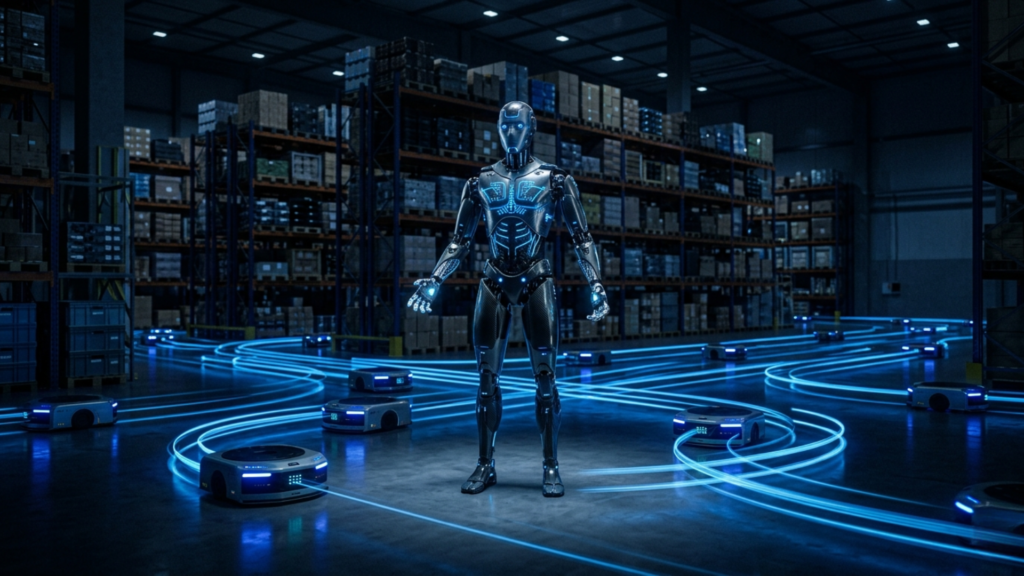
Autonomous Robotics: How AI-Powered Robots Are Reshaping the World We Live and Work In
Robots have moved out of science fiction and off the factory floor. Autonomous Robotics is now operating in hospitals, warehouses, farms, homes, and disaster zones — making decisions, learning from experience, and working alongside humans in ways that are fundamentally changing every industry they touch.
Autonomous Robotics is one of the most rapidly advancing and broadly impactful technology frontiers of 2026. For decades, robots were powerful but brittle — they could perform specific, repetitive tasks with extraordinary precision as long as the environment was perfectly controlled and nothing unexpected happened. The moment something changed, they stopped. They were tools, not agents. That era is ending. The convergence of artificial intelligence, advanced sensors, machine learning, and increasingly capable hardware has produced a new generation of robots that can perceive their environment, reason about what they observe, make decisions, adapt to the unexpected, and learn from experience — all without constant human supervision.
Autonomous Robotics is not a single technology — it is the integration of many technologies into physical systems that can act intelligently in the real world. And the real world, unlike a controlled laboratory environment, is messy, unpredictable, and full of the kind of variation that made previous generations of robots so limited. Teaching machines to navigate that complexity is the central challenge that AI has now made tractable in ways that simply were not possible five years ago.
In this article, we explore exactly what Autonomous Robotics means in 2026, how these systems work, where they are already deployed at scale, what makes this moment different from the false dawns of robotics past, and what the rapid advancement of this field means for businesses, workers, and society.
What Is Autonomous Robotics? Understanding the New Generation
The word robot covers an enormous range of physical systems — from simple conveyor arms that repeat a single motion to sophisticated humanoid machines that can walk, talk, and navigate complex environments. What distinguishes autonomous robotics from traditional industrial automation is the degree to which these systems can operate independently, handle variability, and make decisions without explicit human programming of every possible scenario.
Traditional industrial robots are programmed for specific tasks in controlled environments. They are fast, precise, and tireless — but they require every variable in their environment to be carefully managed. Change the position of a part slightly, introduce an obstacle they have not been programmed to handle, or ask them to perform a slightly different task, and they either fail or stop entirely.
Autonomous robots are fundamentally different. They use sensors — cameras, LiDAR, radar, tactile sensors, ultrasonic detectors — to perceive their environment in real time. They use AI to interpret what they perceive, make decisions about how to act, and adapt their behavior when the environment changes or the unexpected occurs. They can learn from experience, improving their performance over time as they accumulate operational data. And they can operate safely alongside humans in shared, unstructured environments — the environments where most real work actually happens.
The difference between a traditional robot and an autonomous robot is the difference between a very precise tool and a thinking colleague. One does exactly what it is programmed to do. The other figures out what needs to be done.
The Technology Stack Powering Autonomous Robotics in 2026
The capabilities of modern autonomous robots are the product of a sophisticated technology stack where advances in each component have compounded to produce systems far more capable than any single breakthrough could explain:
Computer Vision and Sensor Fusion
Autonomous robots understand their environment primarily through vision — cameras that capture the world as streams of images that AI systems interpret in real time. But vision alone is insufficient for robust real-world operation. Modern autonomous robots fuse data from multiple sensor modalities: cameras for visual detail and color, LiDAR for precise three-dimensional depth mapping, radar for reliable detection in poor visibility conditions, tactile sensors for physical contact feedback, and inertial measurement units for precise position and orientation tracking. Fusing these diverse sensor streams into a coherent, reliable model of the environment is one of the core engineering challenges of autonomous robotics — and solving it is what enables robots to operate reliably across the full range of conditions they encounter in real deployment.
AI Perception and Scene Understanding
Raw sensor data tells a robot what is there — AI perception tells it what it means. Object recognition systems identify and classify everything in the robot’s environment: this is a person, this is a pallet of goods, this is a door that is partially open, this is a surface that is wet and potentially slippery. Scene understanding goes further, inferring context and relationships — this person is walking toward me, this pallet needs to go to location B, this door needs to be pushed to pass through. The depth and accuracy of AI perception is what determines how capable and how safe an autonomous robot can be in a complex real-world environment.
Motion Planning and Control
Knowing what is in the environment is only half the challenge — the robot must also plan and execute physical movements that achieve its goals safely and efficiently. Motion planning systems compute paths through three-dimensional space that avoid obstacles, respect physical constraints, minimize energy consumption, and complete tasks efficiently. Robot control systems translate those planned paths into the precise commands that drive motors, actuators, and joints — handling the real-world physics of moving a physical body through space with the accuracy and smoothness required for safe operation alongside humans and fragile goods.
Machine Learning and Continuous Improvement
Perhaps the most transformative capability of modern autonomous robots is their ability to learn from experience. Reinforcement learning systems allow robots to improve their performance through trial and error — trying different approaches, observing which ones work, and gradually developing more effective strategies. Imitation learning allows robots to acquire new skills by observing human demonstrations rather than requiring explicit programming. And fleet learning — where insights from one robot’s experiences are shared across an entire deployment of similar robots — means that every new robot in a fleet benefits immediately from everything every other robot has learned. This continuous improvement capability is what allows autonomous robots to keep getting better the longer they are deployed.
Autonomous Robotics Across Industries: Where It Is Making Its Biggest Impact
Autonomous Robotics is not confined to any single sector — it is advancing across virtually every industry simultaneously. Here are the deployments where the impact is most significant and most visible in 2026:
Warehousing and Logistics
The explosion of e-commerce has created warehouse operations of staggering complexity — millions of unique products, orders that need to be picked and packed in hours, operational demands that surge unpredictably with promotions and seasons. Autonomous mobile robots are now standard infrastructure in leading fulfillment centers worldwide. These systems navigate dynamically around human workers and each other, retrieve inventory from storage locations, transport goods to packing stations, and manage inventory movements — operating around the clock without breaks, at speeds and accuracy levels that human-only operations cannot match. Amazon’s Proteus, Agility Robotics’ Digit, and a growing roster of specialized warehouse robotics platforms have made autonomous logistics one of the most mature deployment categories in the field.
Manufacturing
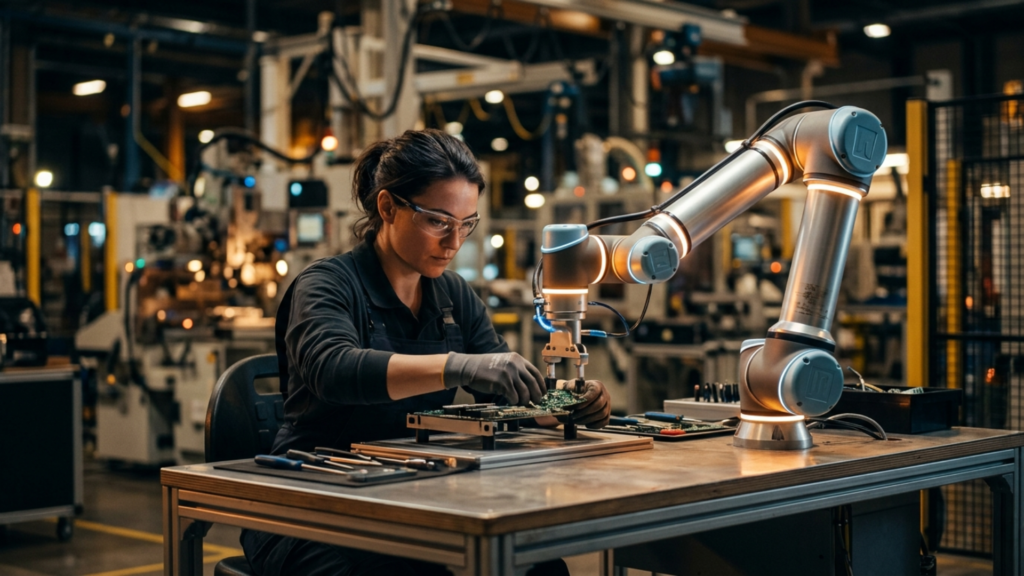
Autonomous robotics is transforming manufacturing far beyond the traditional industrial robot arm bolted to a fixed position on an assembly line. Collaborative robots cubits — work alongside human workers on shared assembly tasks, handling the repetitive, physically demanding, or precision-critical elements of manufacturing processes while humans contribute judgment, dexterity for complex assembly, and quality oversight. Autonomous mobile robots transport components and work-in-progress between workstations, adapting their routes in real time around the dynamic activity of a working factory floor. And AI-powered quality inspection systems examine products at speeds and resolutions that make human visual inspection look rudimentary by comparison.
Agriculture
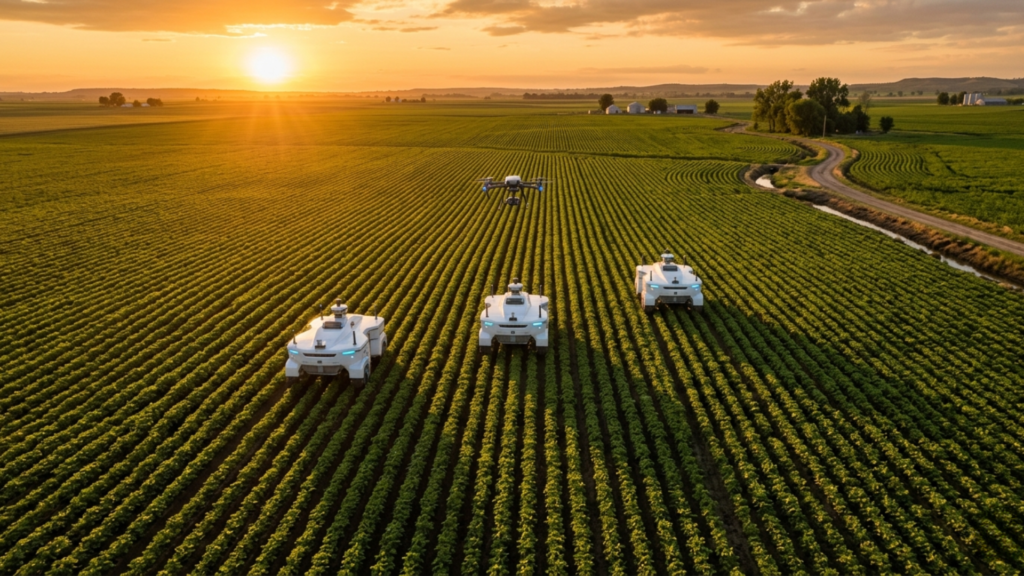
Agriculture faces a profound labor crisis — seasonal labor is increasingly difficult to find and retain, and the physical demands of harvesting, planting, and crop monitoring make it one of the most challenging sectors for human workforce planning. Autonomous agricultural robots are addressing this crisis directly. Autonomous tractors plant and till fields with GPS precision greater than any human driver. Robotic harvesters pick strawberries, apples, and other delicate fruits using computer vision to identify ripe produce and robotic arms nimble enough to harvest without bruising. Drone fleets conduct aerial crop monitoring, applying fertilizer and pesticide with precision that dramatically reduces chemical usage and environmental impact.
Healthcare and Surgery
Autonomous robotics is advancing into some of medicine’s most demanding environments. Robotic surgical systems — led by the da Vinci platform and its successors — give surgeons superhuman precision inside the body, filtering out hand tremor, scaling movements, and providing three-dimensional visualization that makes minimally invasive surgery possible for procedures that previously required open surgery. Hospital logistics robots navigate autonomously through corridors to deliver medications, laboratory samples, and supplies. Rehabilitation robots provide consistent, data-driven physical therapy that adapts to each patient’s progress. And autonomous disinfection robots use UV light and other methods to decontaminate hospital environments with thoroughness and consistency that human cleaning crews cannot achieve.
Construction and Infrastructure
Construction is one of the most dangerous and labor-intensive industries in the world — and one of the least automated. Autonomous robotics is beginning to change this. Robotic bricklaying systems lay walls with precision and speed that dramatically outpace human masons. Autonomous concrete pouring and finishing systems eliminate one of the most physically demanding construction tasks. Drones inspect structures — bridges, towers, wind turbines, pipelines — that are dangerous or impractical for human inspectors to access, detecting structural defects and corrosion with AI-powered analysis of high-resolution imagery. And demolition robots handle hazardous environments where sending human workers would be unacceptable.
Home and Personal Robotics
The robotics revolution is reaching homes. Beyond the robot vacuum cleaners that have been a consumer reality for years, a new generation of home robots is beginning to emerge with genuine autonomous capability. Lawnmowing robots navigate complex garden geometries autonomously. Home assistant robots from companies including Amazon, Samsung, and a growing roster of startups are beginning to handle domestic tasks — fetching items, monitoring home security, assisting elderly or mobility-limited residents with daily activities. The home robotics market is still early but advancing rapidly, and the demographic pressures of aging populations in developed economies are creating powerful economic incentives for capable domestic robots.
Autonomous Robotics and the Future of Work
No discussion of Autonomous Robotics is complete without an honest engagement with its implications for employment. This is one of the most consequential economic and social questions of our era, and it deserves a clear-eyed rather than dismissive treatment.
The historical pattern of automation — from the industrial revolution through the computerization of the twentieth century — has been that technology displaces specific tasks rather than entire jobs, and that the productivity gains from automation ultimately create more jobs than are displaced, though the transition can be painful and uneven for affected workers. There is reason to believe this pattern will hold for Autonomous Robotics — but also reason to take the risks of disruption seriously.
Autonomous robots are currently most capable at tasks that are physically repetitive, structured, and well-defined — exactly the tasks that employ large numbers of workers in manufacturing, logistics, and agriculture. The displacement pressure in these sectors is real and already visible. At the same time, autonomous robots are creating demand for new categories of work: robot operations and maintenance, AI training and supervision, robotics system integration, and entirely new service categories enabled by robotic capabilities.
The question is not whether Autonomous Robotics will change the workforce — it will. The question is whether we invest in the transitions, education, and safety nets that ensure those changes benefit workers as well as the organizations deploying the robots.
The organizations that approach Autonomous Robotics deployment as a human-robot collaboration problem — designing workflows where robots handle what they do best and humans contribute what they do best — consistently report better outcomes than those that treat robotics purely as a headcount replacement strategy. The most effective autonomous robotics deployments augment human capability rather than simply substituting for human labor.
Challenges Facing Autonomous Robotics That Must Be Solved
Despite remarkable progress, Autonomous Robotics faces significant unsolved challenges that are limiting deployment in certain environments and use cases:
- Dexterity and manipulation: Human hands are extraordinary general-purpose tools capable of manipulating objects across an enormous range of sizes, shapes, weights, and material properties. Robotic manipulation is still far behind human dexterity for tasks requiring fine motor control in unstructured environments — handling delicate or irregular objects, operating in tight spaces, or responding gracefully to unexpected physical interactions. This limitation restricts autonomous robot deployment in environments requiring this kind of physical intelligence.
- Real-world generalization: AI systems trained on specific datasets and environments can struggle when deployed in conditions that differ from their training distribution. A robot that navigates a warehouse perfectly may behave unpredictably in a superficially similar but subtly different environment. Building robust generalization across the full range of real-world variability remains one of the hardest open problems in autonomous robotics.
- Safety certification and regulation: Deploying autonomous robots in shared human environments requires demonstrating safety to a standard that regulators, insurers, and the public will accept. Safety certification frameworks for autonomous robots are still developing, and the liability questions around robot accidents are not fully resolved. This regulatory uncertainty is slowing deployment in some of the highest-value application areas.
- Battery life and energy management: Mobile autonomous robots are constrained by the energy density of current battery technology. Operational time between charging cycles limits deployment in continuous round-the-clock operations, and charging infrastructure requirements add to deployment complexity and cost. Advances in battery technology and autonomous charging solutions are improving this rapidly but real constraints remain.
- Cost and return on investment: High-capability autonomous robots remain expensive. The economics of deployment depend heavily on labor costs in the target market, the complexity of the deployment environment, and the maintenance and operational costs over the system’s lifecycle. In markets with lower labor costs or highly variable operational requirements, the ROI case for autonomous robotics is less straightforward than in high-cost labor markets with stable, high-volume operations.
Preparing Your Organization for the Autonomous Robotics Era
Whether you are a business leader evaluating robotics investment or a professional preparing for a workplace transformed by autonomous systems, here is a practical framework for preparation:
- Identify Your Highest-Value Automation Targets
Start by mapping the tasks in your operations that are physically repetitive, high-volume, safety-critical, or operating in environments hazardous to humans. These are your strongest candidates for autonomous robot deployment. Prioritize by the combination of deployment feasibility with current technology and potential operational impact — whether measured in productivity, safety improvement, quality consistency, or cost reduction.
- Think in Terms of Human-Robot Collaboration
Design your robotics deployments from the beginning as human-robot collaborative systems rather than pure automation replacements. The most effective autonomous robotics implementations are those where the handoffs between human and robot capability are carefully designed — where robots handle what they do reliably well, and humans retain responsibility for judgment calls, exception handling, and the tasks that genuinely require human intelligence and adaptability.
- Invest in Your Workforce Transition
Autonomous robotics deployment will change the skills required of your workforce. Invest proactively in retraining and upskilling programs that prepare affected workers for the new roles that robotics deployment creates — robot operations, maintenance, programming, and supervision. Organizations that manage this transition transparently and supportively retain the institutional knowledge and workforce trust that makes robotics deployment successful. - Build Data Infrastructure
Autonomous robots generate enormous volumes of operational data — movement patterns, task completion rates, error logs, sensor readings, maintenance events. Building the data infrastructure to capture, store, and analyze this data from day one is essential for continuous improvement, predictive maintenance, and making the operational case for expanded deployment. Robotics deployments that lack good data infrastructure are flying blind.
Final Thoughts: Autonomous Robotics Is Rewriting What Is Possible
Autonomous Robotics is not a distant future technology or a narrow industrial tool. It is a broad, rapidly advancing capability that is already reshaping the economics and operations of logistics, manufacturing, agriculture, healthcare, construction, and consumer services — and it is accelerating. The robots of 2026 are dramatically more capable than those of 2021, and the trajectory of improvement shows no sign of slowing.
The organizations that engage seriously with Autonomous Robotics now — building understanding of the technology, identifying their highest-value use cases, designing thoughtful human-robot collaborative workflows, and investing in workforce transitions — will be the ones that capture the enormous productivity, safety, and quality advantages that these systems offer. Those that wait for the technology to become mainstream before engaging will find themselves competing against organizations that have years of operational learning and competitive advantage already built.
The age of intelligent machines working alongside humans in the real world is not approaching. It is here. The question every organization needs to answer is not whether to engage with Autonomous Robotics — it is how to engage with it wisely, responsibly, and effectively.
Internal Resources
Read More about AI-Powered Cybersecurity
External Resources
NIH artificial intelligence strategy