

Quantum Computing Explained: What It Is, How It Works & Why It Changes Everything
Quantum Computing is no longer a lab experiment — it is a real, rapidly advancing technology that is already reshaping cybersecurity, drug discovery, finance, and AI. Here is everything you need to understand about it right now.
Quantum Computing is one of the most talked-about and least-understood technologies of our time. You have probably heard the term thrown around in headlines, investor reports, and tech conferences — often accompanied by bold claims about it solving problems that would take today’s computers millions of years to crack. But what does that actually mean? How does Quantum Computing work? And more importantly, what does it mean for your business, your industry, and the future of technology as we know it?
In this article, we cut through the hype and give you a clear, honest, and practical understanding of Quantum Computing — where it stands today, what it can and cannot do, which industries it is already beginning to transform, and what every forward-thinking professional needs to know heading into the next few years.
What Is Quantum Computing? A Clear, Simple Explanation
To understand Quantum Computing, you first need to understand how traditional computers work — and where they hit their limits.
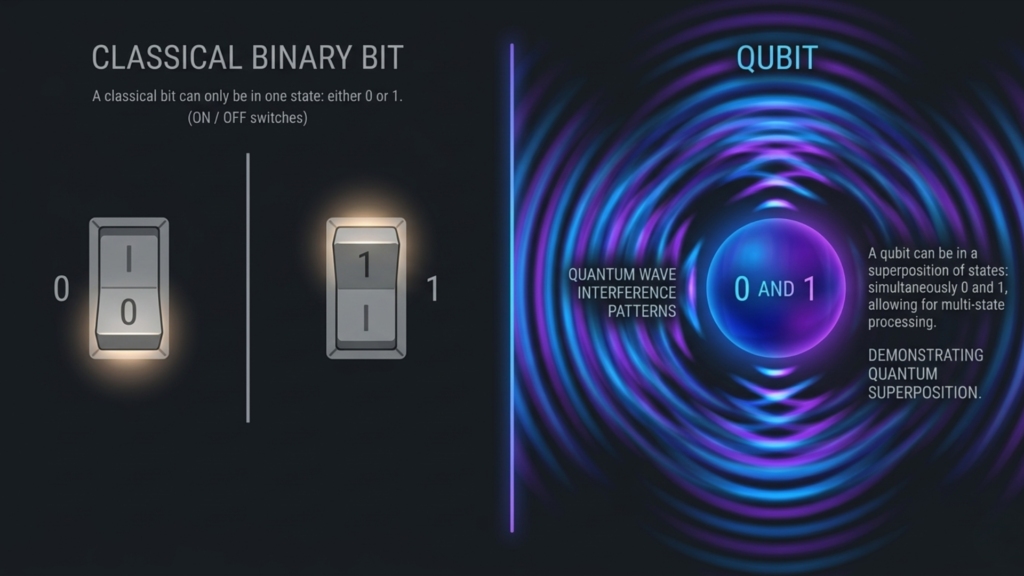
Every classical computer — your laptop, your smartphone, the servers powering the internet — processes information using bits. A bit is the smallest unit of data, and it can hold one of two values: 0 or 1. Every calculation, every piece of software, every digital interaction in the world ultimately boils down to billions of these binary switches flipping on and off at extraordinary speed.
Classical computers are extraordinarily good at this. But there are certain categories of problems — ones that involve exploring an astronomical number of possible combinations simultaneously — where even the fastest classical supercomputers in the world would take longer than the age of the universe to find a solution.
Quantum Computing approaches this differently. Instead of bits, quantum computers use quantum bits — called qubits. And qubits behave according to the rules of quantum mechanics, which opens up capabilities that are simply impossible for classical systems.
Classical computers are like a single explorer trying every path through a maze one at a time. Quantum Computing is like releasing a wave that flows through all paths simultaneously — finding the exit far faster than any sequential search ever could.
The Quantum Computing Principles That Make It So Powerful
Three core principles of quantum mechanics give Quantum Computing its extraordinary capabilities. Understanding these principles is the key to understanding why this technology matters so much:
Superposition — Being in Two States at Once
A classical bit is either 0 or 1 — it cannot be both at the same time. A qubit, thanks to the principle of superposition, can exist as 0, 1, or any combination of both simultaneously — until it is measured. This means a quantum computer with just 300 qubits can represent more states simultaneously than there are atoms in the observable universe. The computational parallelism this enables is staggering.
Entanglement — Instant Correlation Across Distance
When two qubits become entangled, the state of one instantly influences the state of the other — regardless of the physical distance between them. This is one of the most counterintuitive phenomena in all of physics, famously described by Einstein as ‘spooky action at a distance.’ In Quantum Computing, entanglement allows qubits to work together in ways that dramatically multiply computational power with each additional qubit added to the system.
Interference — Amplifying the Right Answers
Quantum algorithms use interference to increase the probability of reaching correct answers and decrease the probability of reaching wrong ones. Think of it like noise-canceling headphones — destructive interference cancels out the bad solutions, while constructive interference amplifies the good ones. This is what allows quantum algorithms to zero in on correct solutions far more efficiently than classical trial-and-error approaches.
Where Quantum Computing Stands Today in 2026
For years, Quantum Computing existed almost entirely in research laboratories. That is changing rapidly. Here is an honest picture of where the technology stands right now:
The Race for Quantum Supremacy
Google made headlines in 2019 when it claimed its 53-qubit Sycamore processor completed a calculation in 200 seconds that would take a classical supercomputer approximately 10,000 years. IBM, Microsoft, IonQ, and a growing roster of well-funded startups have been racing to outpace each other ever since. By 2026, leading quantum processors are operating at scales that were considered science fiction just five years ago.
The Current Limitations
It is important to be honest about where quantum technology still falls short. Today’s quantum computers are what experts call ‘noisy intermediate-scale quantum’ (NISQ) devices. They are powerful but error-prone. Qubits are extraordinarily sensitive to environmental disturbances — even minor vibrations or temperature fluctuations can cause errors. Maintaining the ultra-cold temperatures required for superconducting qubits (near absolute zero, colder than outer space) demands enormous engineering effort and cost.
This means that for most practical applications, classical computers remain more efficient today. The era of fault-tolerant, large-scale quantum computing — where quantum decisively outperforms classical across a broad range of problems — is still several years away. But it is coming, and the organizations preparing now will have a significant head start.
Quantum Computing as a Cloud Service
One of the most significant developments of recent years is the availability of quantum computing power via the cloud. IBM Quantum, Amazon Braket, Microsoft Azure Quantum, and Google Quantum AI all offer access to real quantum hardware and simulators through cloud platforms. This means organizations do not need to build or own quantum hardware to begin experimenting with the technology — they can start today, with existing infrastructure.
Quantum Computing Use Cases: Industries Being Transformed
While general-purpose quantum computing is still maturing, there are specific problem domains where it is already demonstrating genuine advantages. Here are the industries where Quantum Computing is beginning to make its mark:
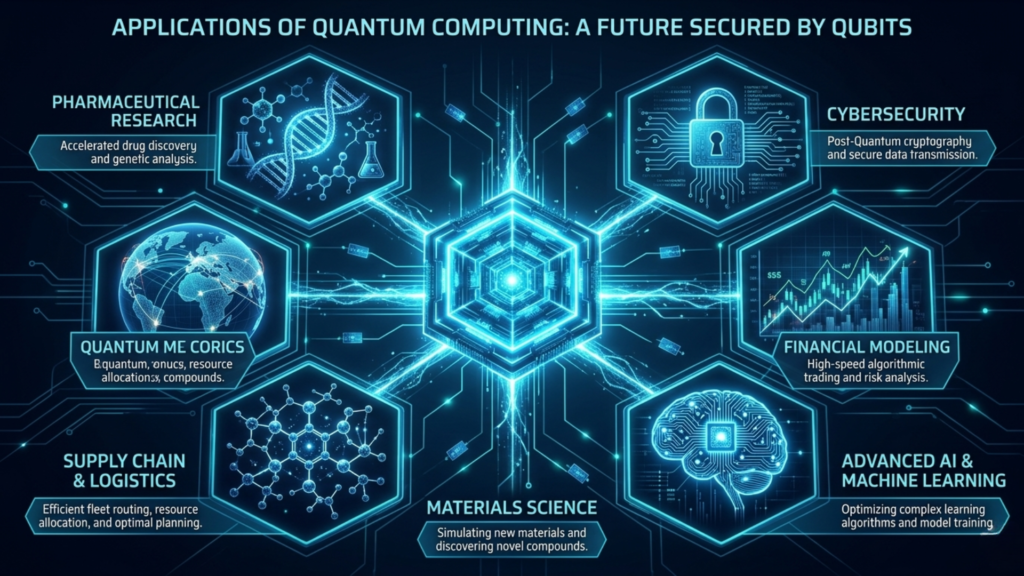
Cybersecurity — The Most Urgent Implication
This is where Quantum Computing has the most immediate and serious implications. Most of the encryption that secures the internet today — protecting banking transactions, government communications, healthcare records, and private messages — relies on the mathematical difficulty of factoring very large numbers. Classical computers would take thousands of years to crack these codes. A sufficiently powerful quantum computer could potentially do it in hours.
This is not a distant threat. Security experts are already warning about ‘harvest now, decrypt later’ attacks — where adversaries collect encrypted data today with the intention of decrypting it once quantum computers become powerful enough. Governments and major enterprises have already begun transitioning to post-quantum cryptography standards to get ahead of this risk.
Pharmaceuticals and Drug Discovery
Developing a new drug is extraordinarily complex. It requires simulating the behavior of molecules at the quantum level — understanding exactly how atoms interact, how proteins fold, and how a potential drug compound will behave inside the human body. Classical computers can only approximate these simulations. Quantum computers can model molecular behavior with native quantum precision, potentially compressing drug development timelines from decades to years and dramatically reducing the cost of bringing life-saving treatments to market.
Financial Services — Optimization at Scale
Financial institutions deal with optimization problems of breathtaking complexity — portfolio optimization across thousands of assets, risk modeling across millions of scenarios, fraud detection in real-time transaction streams. Quantum algorithms are particularly well-suited to these types of combinatorial optimization challenges. Major banks and hedge funds are already running quantum experiments, and some are reporting meaningful advantages over classical approaches for specific problem types.
Artificial Intelligence and Machine Learning
Quantum Computing and AI are on a collision course — and the impact of their convergence could be profound. Quantum machine learning algorithms have the theoretical potential to train models faster, identify patterns in vastly larger datasets, and solve optimization problems that are currently intractable for classical AI systems. The full realization of quantum-enhanced AI is still ahead of us, but the foundational research is accelerating rapidly.
Climate and Materials Science
Some of the most pressing challenges facing humanity — designing better batteries for energy storage, developing more efficient solar cells, creating carbon capture materials — require precisely the kind of molecular-level simulation that Quantum Computing excels at. Breakthroughs in materials science enabled by quantum simulation could accelerate the clean energy transition in ways that classical computing simply cannot match.
Quantum Computing Risks Every Organization Should Understand
The power of Quantum Computing is matched by the scale of its risks. Organizations that fail to prepare for the quantum era face serious vulnerabilities:
- Cryptographic vulnerability: Any organization that handles sensitive data protected by current encryption standards needs a post-quantum cryptography migration plan. The question is not whether to migrate — it is how quickly you can do it before quantum-capable adversaries arrive.
- Competitive displacement: Industries where quantum optimization provides decisive advantages — finance, logistics, pharmaceuticals — will see early adopters pull significantly ahead of competitors still relying on classical approaches. The window for preparation is open now, but it will not stay open indefinitely.
- Talent scarcity: Quantum computing expertise is extraordinarily rare. Organizations that begin building quantum literacy now — even at a basic level — will be far better positioned to attract, develop, and retain the talent needed to compete in a quantum-enabled future.
- Vendor lock-in: As quantum cloud platforms mature, organizations that build deep dependencies on a single provider risk significant switching costs. A platform-agnostic approach to quantum experimentation is wise at this stage of the market’s development.
- Overhyped expectations: Quantum Computing will not solve every problem faster than classical computers. Organizations that invest in quantum solutions for problems better suited to classical approaches will waste resources and face disappointment. Careful problem selection is essential.
How to Prepare Your Organization for the Quantum Computing Era
You do not need to wait for fault-tolerant quantum computers to arrive before you start preparing. Here is a practical roadmap for organizations at any stage of quantum readiness:
- Start with Quantum Literacy
You cannot make good strategic decisions about a technology your leadership team does not understand. Invest in foundational quantum education — not deep technical training for everyone, but enough conceptual understanding that decision-makers can evaluate quantum opportunities and risks intelligently.
- Audit Your Cryptographic Infrastructure
Identify every system in your organization that relies on encryption. Prioritize those that protect long-lived sensitive data — the kind of information that would still be valuable to an adversary in ten years. Begin the planning process for migrating these systems to post-quantum cryptographic standards. The National Institute of Standards and Technology finalized its first post-quantum cryptography standards in 2024 — they are available and ready to implement.
- Identify Your Quantum-Relevant Problems
Work with your technical teams to identify the specific optimization, simulation, or machine learning problems in your operations that might benefit from quantum approaches. These are your future use cases. Understanding them now positions you to act quickly when the technology reaches the maturity threshold for your problem domain.
- Experiment Through Cloud Access
You do not need to buy a quantum computer. Use IBM Quantum, Amazon Braket, or Azure Quantum to begin hands-on experimentation with quantum algorithms today. Even at small scale, this experimentation builds institutional knowledge and identifies which problems in your specific context are genuinely quantum-appropriate. - Watch the Standards Landscape
Quantum computing standards — for both hardware performance benchmarking and post-quantum cryptography — are evolving rapidly. Staying current with NIST, ISO, and industry consortium developments will ensure your preparations remain aligned with where the technology and regulatory environment are heading.
Final Thoughts: Quantum Computing Is Not the Future — It Is the Present
Quantum Computing is not a technology you can afford to dismiss as distant or irrelevant. It is advancing faster than most people realize, its implications for cybersecurity are already urgent, and the industries that will be most profoundly transformed by it are already deep into their preparation and experimentation.
The honest picture is nuanced: we are not yet in the era of universal quantum advantage, and the most dramatic applications are still a few years away from practical deployment at scale. But the organizations that understand this technology, prepare their infrastructure, and build their quantum capabilities today will be the ones that lead their industries when that era arrives.
Quantum Computing will not change everything overnight. But it will change everything — and the time to understand it, prepare for it, and position yourself ahead of it is right now.